

Introduction: MSG prices have generally risen after the Spring Festival in the past five years, with a particularly strong upward trend in 2021-2022 and 2024-2025. This was mainly due to increased downstream demand, easing market supply and demand pressures, and stronger cost support. In February of this year, the MSG industry's operating rate declined while costs remained high, which may have a positive impact on post-holiday price trends.
According to data monitored by Zhuochuang Information, the MSG market price has shown a trend of divergence around the Spring Festival in the past five years. MSG price increases in February and March mainly occurred in 2021-2022 and 2024-2025. Increased consumption during the holiday and restocking demand after the holiday effectively supported price increases, coupled with rising cost pressures. The most significant price increase was observed after the Spring Festival in 2022 (February-March), with a month-on-month increase of 7.7 percentage points. In contrast, in 2023, prices trended downward due to high operating rates and declining raw material costs, with a month-on-month decrease of 1.4 percentage points.
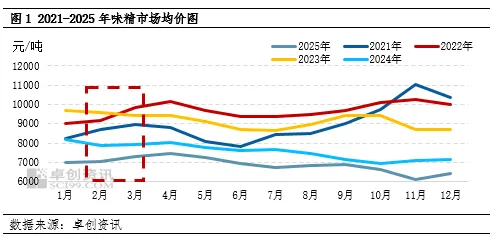
Increased demand and rising costs are the main reasons for the price increase.
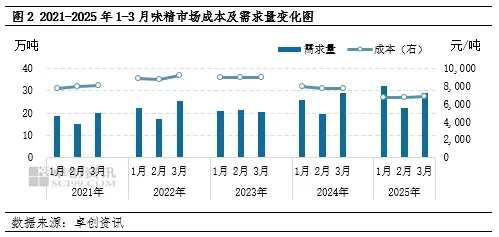
Since MSG prices rose significantly around the Spring Festival in 2022 and 2025, increasing by 7.7% and 3.5% month-on-month respectively, this analysis uses changes in demand and cost data from these two years as examples. Firstly, on the demand side, the operating rate of production capacity declined by 5 percentage points month-on-month around the Spring Festival in 2022 (February-March). With the decrease in operating rate, market supply pressure eased, and companies' confidence in maintaining prices strengthened, leading to a bullish sentiment. Furthermore, although prices were at a near five-year high, downstream market sentiment remained bullish, resulting in active purchasing after the holiday and driving a sustained recovery in demand. In March, demand rebounded by 47.8% month-on-month. Secondly, on the cost side, production costs increased by 4.8 percentage points around the holiday, significantly increasing the positive impact of cost factors. It can be seen that during this period, supported by tight supply and demand and increased costs, MSG prices showed an upward trend after the Spring Festival. Looking ahead to 2025, costs will also be increasing, with a 2.3 percentage point increase in March compared to the previous month. This will put greater pressure on companies' costs and strengthen their willingness to maintain prices. In addition, downstream markets will see active sales after the Spring Festival, with demand rebounding by 30.8%. Both demand and cost factors will be beneficial to the upward trend of MSG prices.
MSG prices may continue to rise after the 2026 Spring Festival.
Looking at the market outlook after the 2026 Spring Festival, starting in January 2026, enterprises in Heilongjiang Province experienced a gradual decline in operating rates due to losses and unstable production processes. The industry's operating rate dropped from a high of 94.4% in November to 89.2%, a difference of 5.2 percentage points. This gradual decline in MSG operating rates, coupled with a shortage of continuously crystallized MSG and downstream customers stocking up for the year-end, resulted in a tight supply and demand situation. Data from Zhuochuang Information shows that the monthly operating rate of the MSG industry in the two months before the Spring Festival this year is estimated at 82%, a month-on-month decrease of 9.1 percentage points. Industry output is gradually decreasing, easing the supply pressure in the MSG market. Meanwhile, after digesting the effects of the Spring Festival, downstream markets are mainly replenishing their stocks to meet immediate needs, leading to a certain degree of recovery in demand.
From a cost perspective, starting in March, as temperatures rise, farmers' willingness to sell grain may increase, and trading companies and downstream enterprises may gradually increase their inventories. This could lead to some selling pressure in certain regions, causing corn prices to decline temporarily, but overall remaining relatively strong. The average corn price in March is expected to be 2259 yuan/ton, a decrease of only 4 yuan/ton compared to the previous month. The prices of raw materials such as corn, sulfuric acid, and coal remain relatively high, making it difficult to significantly alleviate cost pressures on enterprises. Therefore, it seems that in early 2026, the monosodium glutamate (MSG) industry will be influenced by a temporary tight supply and demand situation coupled with a slight decrease in costs, suggesting that prices may continue to rise.
In summary, after the Spring Festival in 2026 (late February to March), downstream industrial and distribution markets will have rigid restocking demand, at which time demand is likely to rebound. At this time, the supply side may show a downward trend compared to the previous period. The tight supply and demand in the monosodium glutamate (MSG) market will drive prices to continue to be strong. It is estimated that after the holiday, the price of 40-mesh MSG in Inner Mongolia will be 6,700 yuan/ton, an increase of 75 yuan/ton compared to the average price before the holiday. The price of fine crystal MSG may rise to 6,100 yuan/ton, an increase of 200 yuan/ton compared to the price before the holiday.
Source: Zhuo Chuang Information)