

[Introduction] In the first quarter of 2026, the spot price of cassava starch was on an upward trend, reaching its highest point since 2025 by the end of the quarter. Continued increases in international prices, tightened supply in the distribution sector, and supportive downstream demand all contributed to the rise in spot prices. The supply-demand relationship in the market is expected to ease in the second quarter, with spot prices potentially rising before the end of April, and possibly declining in May and June.
Cassava Starch Spot Prices Continue to Rise in the First Quarter
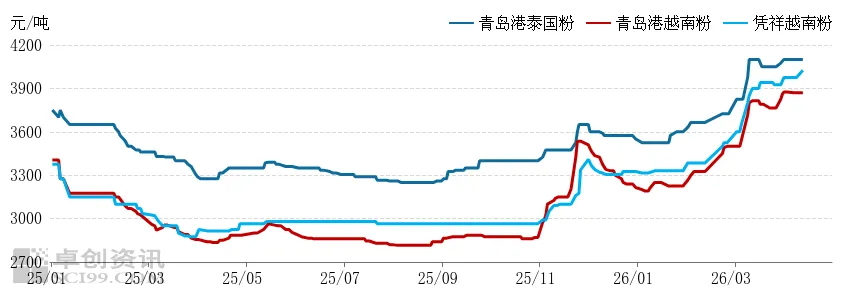
In the first quarter of 2026, the spot price of cassava starch was on an upward trend, with rising import costs and tightening supply having a consistent positive impact on prices. The price increase accelerated in March, with a temporary increase in downstream demand further fueling the price rise. According to Zhuochuang Information, as of March 31, the mainstream transaction price of Vietnamese cassava starch at Qingdao Port was 3800-3920 yuan/ton, an increase of 660 yuan/ton compared to the beginning of January, a rise of 20.63%, and a year-on-year increase of 35.20%. In the first quarter, the average transaction price of Vietnamese pork fines at Qingdao Port was 3,450 yuan/ton, an increase of 9.38% compared to the previous quarter and 11.98% year-on-year. The price low occurred in early January at 3,190 yuan/ton, and the price high occurred at the end of March at 3,860 yuan/ton.
International Cassava Starch Prices Continue to Rise, Import Costs Reach High Levels
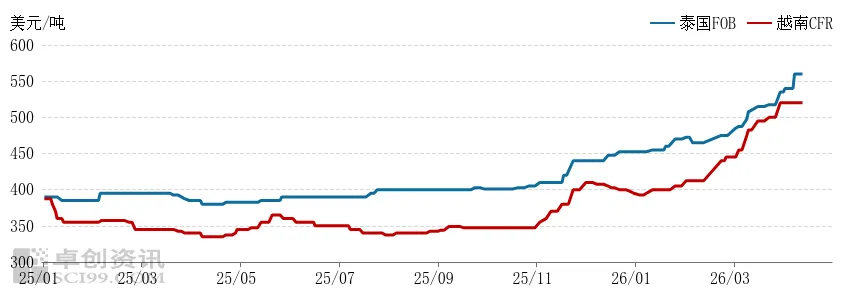
International cassava starch prices continued to rise in the second quarter, with import costs reaching their highest level since 2025. Rising costs and limited production were the main driving factors. From a cost perspective, Southeast Asian cassava production in 2025/26 is expected to decrease year-on-year, leading to price increases after the product hit the market. In March, geopolitical tensions in the Middle East limited transportation capacity and increased freight costs, making cassava procurement more difficult and further pushing up prices. According to Zhuochuang Information, cassava prices in Vietnam and Thailand rose by more than 30% cumulatively in the first quarter. From a supply perspective, the supply of raw cassava is difficult to guarantee, with factories generally operating intermittently and experiencing periods of shutdown. International cassava starch production is limited, and factories are maintaining a price-supporting stance.
As of March 31, the international price of Thai cassava starch was quoted at $520-550/ton FOB, an increase of $82.50/ton from the beginning of January, representing a rise of 18.23% and a year-on-year increase of 38.96%. Vietnamese cassava starch is quoted at CFR $500-540/ton, up $127.50/ton from the beginning of January, a 32.48% increase, and up 52.94% year-on-year. Therefore, the continued rise in international prices and the increasing import costs are providing strong support for rising spot prices.
Domestic port arrivals decreased, tightening supply in the distribution chain.
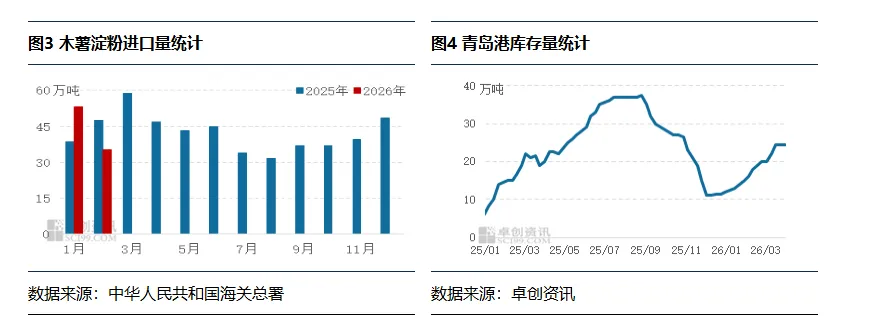
In the first quarter, international prices continued to rise, exacerbating the price inversion between domestic and international markets. Traders were reluctant to import, leading to a downward trend in cassava starch imports. According to data from the General Administration of Customs of the People's Republic of China, cassava starch imports reached 530,500 tons in January, with concentrated arrivals at domestic ports. February imports totaled 351,200 tons, a decrease of 33.79% month-on-month and 25.99% year-on-year. March imports are expected to decrease further. Looking at domestic port inventories, the market was in a phase of inventory accumulation in the first quarter, but the growth rate gradually slowed. According to Zhuochuang Information, as of March 31, Qingdao Port's inventory was approximately 240,000-250,000 tons, an increase of 125,000 tons from the beginning of January, representing a 104% increase, and a 22.50% increase from the end of February. Reduced new supply at domestic ports, coupled with continuously rising import costs, led traders to generally hold firm on prices and be reluctant to sell, tightening supply in the distribution chain and providing bullish support for spot prices.
The operating rate of vermicelli factories declined quarter-on-quarter in the first quarter, limiting demand support for spot prices.
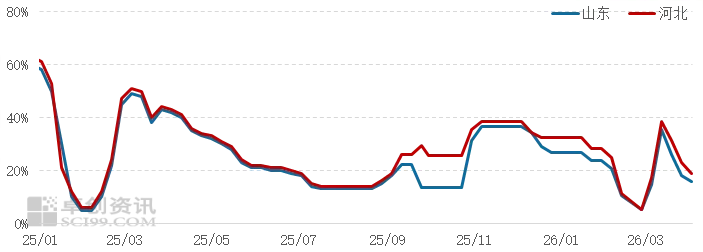
While the domestic food and industrial sectors remained in their traditional peak season in the first quarter, demand decreased compared to the fourth quarter of 2025, leading to a decline in the operating rate of downstream factories. Taking the vermicelli industry as an example, according to Zhuochuang Information, the average operating rate of vermicelli factories in the first quarter was 22.15%, a decrease of 8.87 percentage points compared to the fourth quarter of 2025. Looking at different phases, downstream vermicelli demand decreased in January and February, resulting in a decline in vermicelli factory operating rates. The monthly average operating rate dropped from 27.85% to 13.01%, a decrease of 14.84 percentage points. Limited purchases of cassava starch, driven by immediate needs, had no impact on spot prices. After the Spring Festival, vermicelli demand improved temporarily, and the operating rate of vermicelli factories rose. The average operating rate in March reached 25.59%, an increase of 12.58 percentage points compared to February. Increased demand for cassava starch from vermicelli factories in March, with concentrated purchases in the first half of the month, boosted spot prices.
Downstream demand is weak during the off-season, and spot prices may rise first and then fall in the second quarter.
On the cost side: The peak cassava starch crushing season in Southeast Asia has passed in the second quarter, resulting in reduced new cassava starch production. The average price on the international market is likely to be higher than in the first quarter. With cassava prices unlikely to fall and cassava starch production limited, international prices are expected to remain high in mid-to-late April, supporting spot prices. The significant price inversion between domestic and international markets has reduced traders' import enthusiasm, leading to insufficient international demand. In May and June, foreign factories may soften their price-holding stance and offer discounts to attract orders, potentially causing international prices to fall.
On the supply side: The import dependence of cassava starch is over 94%, and changes in total domestic supply depend on changes in import volume. Small-scale arrivals at ports are expected in the second quarter, while the domestic market is in a destocking phase. Currently, trading profits are considerable, and some traders are shipping moderately. Supply in the distribution sector may increase in mid-April, but after the completion of these phased shipments, supply in the distribution sector may tighten again in the latter half of the month. To alleviate funding and inventory pressures in May and June, traders are more willing to ship goods, leading to a looser supply in the distribution chain and a negative impact on spot prices.
On the demand side: The second quarter is traditionally the off-season for the food industry, with market demand decreasing compared to the first quarter. Looking at the vermicelli industry, rising temperatures across regions and unfavorable dietary habits have led to a decline in vermicelli factory operating rates, reducing demand for cassava starch. Vermicelli factories depleted their previous cassava starch inventory in mid-April, and a period of restocking may occur in late April. In May and June, there will be more instances of temporary shutdowns at vermicelli factories, resulting in small-scale purchases of cassava starch with no significant market impact. In the paper industry, the price of corn starch, a substitute, may decline in the second quarter, while the price difference between the two remains high, increasing the substitutability of corn starch. Cassava starch has a low cost-performance ratio, and end-user paper companies are making small-scale purchases based on immediate needs.
In conclusion, the spot price of cassava starch in the second quarter may rise initially and then fall. The supply and demand relationship in the distribution chain was slightly loose in April, and spot prices may decline. However, high import costs may support the bottom price, and the expected decline in Vietnamese fines spot prices is within 30 yuan/ton. In the latter half of the month, supply in the distribution sector will tighten, and with improved demand, spot prices may rise, with the potential increase in Vietnamese fines prices possibly reaching 50-100 yuan/ton. In May and June, import costs will decrease, leading to oversupply in the domestic market. Driven by these negative factors, spot prices may decline in May and June, with the expected decline in Vietnamese fines prices potentially exceeding 100 yuan/ton.
Source: Zhuo Chuang Information)