

[Introduction]: Domestic MSG prices experienced two consecutive rounds of increases in 2025. The first round lasted from February 16th to April 22nd, and the second round from November 17th to December 31st. MSG prices continued their upward trend into January 2026. Both rounds saw price increases from major brands to varying degrees, driven by increased market demand and rising costs. However, compared to the first round, the price increases by manufacturers were more pronounced in the second round, with continuous crystallization showing a significantly larger price increase than the first round. Given the difficulty in significantly alleviating cost and loss pressures, MSG manufacturers are expected to continue maintaining high prices in January and February 2026, with the market likely to remain in a high-level stalemate, and the average price possibly rising month-on-month.
During the two rounds of price increases, major brands in producing areas raised prices in a consistent manner, but the price increases for continuous crystallization varied.
In 2025, domestic MSG prices experienced two consecutive rounds of increases. The first round lasted from February 16th to April 22nd, and the second round from November 17th to December 31st. During both rounds, prices for major brands rose, but the second round showed a more pronounced strength and structural characteristics. Compared to the first round, the second round not only saw a higher overall increase but also exhibited significant differentiation between brands and crystal forms. According to data monitored by Zhuochuang Information, the average price increase for major MSG brands in the second round reached 7.8%, a 0.7 percentage point increase from the 7.1% average in the first round, with the Furui brand showing a particularly significant increase. The core reason for this difference lies in the fact that during the second round of price increases, the average price of corn, the main raw material, rose by 3.2%, driving up production costs. Most major companies in the industry were in a loss-making state, and their mentality of passing on costs through price increases was highly unified, forming a stronger combined force for price increases. Simultaneously, during both rounds of price increases, increased demand for low-priced stockpiling in the terminal market, coupled with simultaneous efforts in both domestic and international sales, led to a tight supply of MSG of various crystal forms. In the second round, the price increase of continuously crystallized products was more impressive due to increased terminal orders and reduced production by some companies, resulting in a supply shortage and strong demand. The price increase was 2.7 percentage points larger than that of the first round.
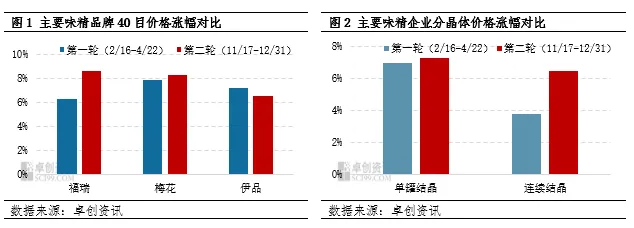
In two rounds of price increases, production areas led the way while sales areas lagged behind, resulting in a persistent gap in price increases.
During the two rounds of MSG price hikes, market prices in both production and sales areas rose simultaneously, but sales areas consistently lagged behind and saw smaller increases. According to data monitored by Zhuochuang Information, during both price increase cycles, the price increase in production areas was greater than that in sales areas. In the second round of increases, the gap widened to 1.5 percentage points. This phenomenon is the result of multiple market factors: On the one hand, the large number of MSG brands in the industry provides downstream consumers with ample choices, leading to particularly fierce competition in sales areas and limiting the elasticity of price increases; on the other hand, while the supply of goods in sales areas is relatively abundant, the rate of consumption by end consumers is slow, resulting in a long-term state of inverted sales, making it difficult for traders to raise prices and keep pace with the price increases of leading manufacturers. Furthermore, some small and medium-sized brands, limited by their own market competitiveness, had limited price increases, which also dragged down the overall market price in sales areas, further widening the gap in price increases between production and sales areas.
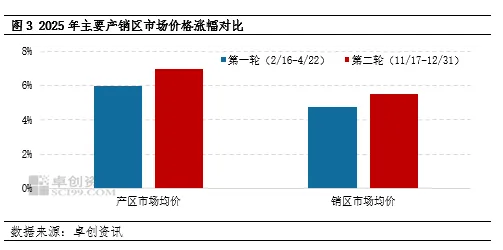
Cost and Demand as Dual Drivers Throughout Two Price Hike Cycles
The underlying logic of the two rounds of MSG price increases is highly consistent, both driven by a market structure of weak supply and strong demand, coupled with increasing raw material costs. Specifically, in the first round of price increases from February 16th to April 22nd, the recovery of offline consumption scenarios such as dine-in restaurants accelerated after the Spring Festival holiday. This, combined with the natural depletion of terminal inventory during the Spring Festival, led to restocking demand from downstream terminals and traders, driving a rebound in MSG consumption. Simultaneously, the price of corn, a major raw material, entered a continuous upward trend, increasing the cost pressure on MSG companies by a cumulative 2.3 percentage points from February to March. The pressure from cost-side constraints and demand-side support resonated, jointly driving this round of price increases.
The core driver of the second round of price increases was the combined effect of cost and loss pressures, channel stockpiling, and a recovery in demand sentiment. Prior to this, the MSG market experienced multiple rounds of price declines in September and October, leading to a sustained increase in risk aversion within the industry and a reduction in channel inventory to low levels. Against this backdrop, downstream traders and end-user companies were the first to express their intention to stockpile at low prices. As market prices continued to rise, the traditional mentality of "buying when prices rise, not when they fall" gradually became prominent, and purchasing sentiment shifted from wait-and-see to active, leading to a rapid rebound in market demand. According to data monitored by Zhuochuang Information, monosodium glutamate (MSG) demand in November rebounded by 10.3 percentage points month-on-month. At the same time, the continued rise in the prices of raw material corn and various auxiliary materials has put significant cost pressure on MSG producers. In November, the average production cost of MSG companies reached 7,226.02 yuan/ton, a month-on-month increase of 2.7%, continuously squeezing the profit margins of enterprises and leading to losses. To alleviate the pressure of losses, companies in the industry are increasingly willing to raise prices to pass on the losses, coupled with production cuts, and multiple factors have jointly driven the current rise in MSG prices.
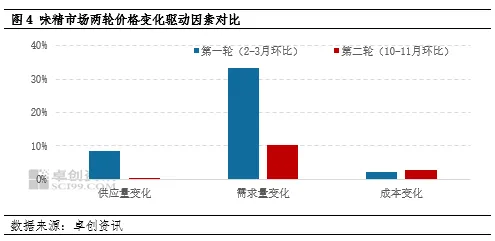
In summary, both rounds of MSG price increases exhibited the core characteristics of "leading price increases in production areas and driven by both cost and demand." During the second round of increases, a unified price-supporting mentality among upstream suppliers created a positive resonance, further strengthening the upward trend. However, the lagging pace of price increases in sales areas and weak end-consumer demand remained fundamentally unchanged, resulting in a differentiated market transmission. Looking ahead to January and February 2026, the pre-Spring Festival stockpiling period will support some downstream restocking demand. However, current MSG prices are already relatively high, and insufficient end-consumer demand will limit further price increases. Overall, the MSG market is likely to maintain a high-level stalemate in January and February, with the average price potentially rising month-on-month. The average price for 40-mesh MSG from major manufacturers is expected to be around 6550 yuan/ton.
Source: Zhuo Chuang Information)