

1. Market Review: Spot and International Prices Rise
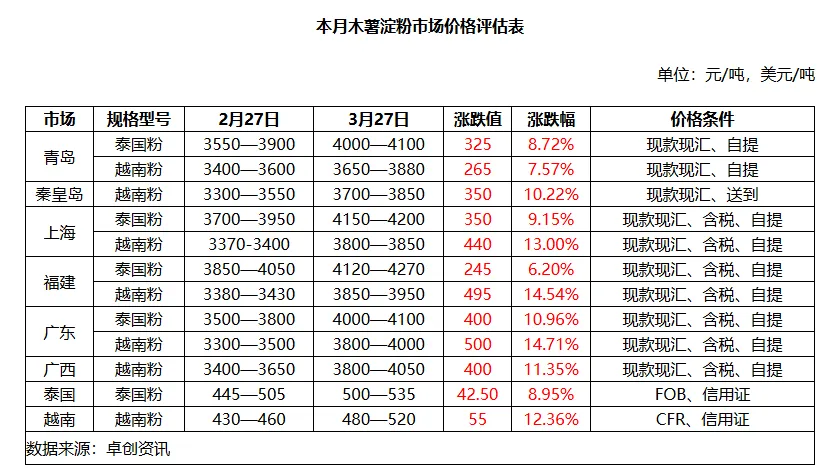
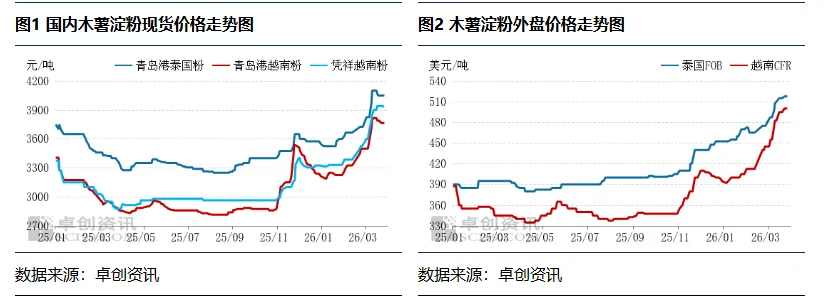
Domestic cassava starch spot prices rose in March. As of March 27, the mainstream transaction price of Thai cassava starch in Qingdao was 4000-4100 yuan/ton, an increase of 325 yuan/ton or 8.72% compared to February 27. The mainstream transaction price of Vietnamese cassava starch in Qingdao was 3650-3880 yuan/ton, an increase of 265 yuan/ton or 7.57% compared to February 27. International cassava starch prices continued to rise in March. As of March 27, the intended transaction price of Thai cassava starch was FOB 500-535 USD/ton, an increase of 42.50 USD/ton or 8.95% compared to February 27. The mainstream intended transaction price of Vietnamese cassava starch was CFR 480-520 USD/ton, an increase of 55 USD/ton or 12.36% compared to February 27.
2. Driving Factors: Rising Costs and Tight Supply Lead to Significant Spot Price Increases
Domestic: Domestic cassava starch spot prices rose in March. The price increase was significant in the first half of March, with both cost and supply/demand factors favoring the spot market. International prices continued to rise, significantly increasing import costs. Domestic traders held firm on prices and were reluctant to sell, tightening supply in the distribution chain. Downstream factories saw increased operating rates, boosting demand for cassava starch. Prices gradually stopped rising in late March, with Qingdao leading the decline in the mainstream market. Ports saw continued arrivals, and some traders actively sold, increasing supply in the distribution chain. Reduced downstream demand led to an oversupply, negatively impacting spot prices.
International: International cassava starch prices continued to rise in March. Reduced supply and rising costs were the main reasons. From a supply perspective, reduced cassava production in Southeast Asia made it difficult to guarantee raw material supply for cassava starch production. Factories generally operated intermittently, limiting new cassava starch production. From a cost perspective, the price of raw cassava has risen, and due to the geopolitical situation in the Middle East, Southeast Asian transportation capacity is limited and freight costs have increased, further increasing the difficulty and cost of cassava procurement.
3. Market Forecast: Spot prices may fluctuate between decline and rise over the next three months; attention should be paid to changes in arrival volume and costs.
It is expected that the spot price of cassava starch will fluctuate between decline and rise over the next three months. In April, domestic ports will see a steady influx of goods, and warehouses will have a certain amount of inventory, some of which will enter the distribution channels. As the market enters the traditional off-season, supply and demand in the distribution channels may be relatively loose in April, and spot prices may decline. Under the influence of the Middle East situation, port arrival volume and arrival costs are variables that may affect spot price changes. In May, driven by high costs and tight supply, spot prices may rebound. In June, downstream demand will be weak, and the market may return to its supply and demand dynamics, with spot prices still likely to decline and adjust. The average spot price at Qingdao Port is expected to be 3,850 yuan/ton, 3,900 yuan/ton, and 3,875 yuan/ton in April, May, and June, respectively, with month-on-month changes of -0.18%, 1.30%, and -0.64%.
Source: Zhuo Chuang Information)