



Products Description
Castor oil contains a large amount of castor oil acid (over 80%), thus having the following properties:
1. It is easily soluble in ethanol and hardly soluble in petroleum ether. (Distinguishing castor oil from other oils)
2. Its viscosity is much higher than that of common oils.
3. Castor oil has good fluidity.
4. It has a strong optical rotation.
5. Its dielectric constant is approximately 4.30, which is the highest among common oils.
6. The relative density and acetyl value of castor oil are both higher than those of common oils.
7. Castor oil hardly undergoes oxidative rancidity in the air and has good storage stability, being a typical non-drying liquid oil.
Density: 0.955 - 0.970 g/cm³
Refractive index: 1.4765 - 1.4819
Viscosity: greater than 14
Melting point: -18 - 10 °C
Iodine value: 82 - 86 g iodine/100 g oil
Saponification value: 176 - 187 mg KOH/g oil
Total fatty acid content is approximately 96%
Average molecular weight of fatty acids: 290 - 300
Fatty acid composition of castor oil:
Stearic acid: 0.5 - 3.0%, dihydrostearic acid: 0.6 - 2.0%, oleic acid: 3 - 9%, linoleic acid: 2.0 - 3.5%, ricinoleic acid: 80 - 88%
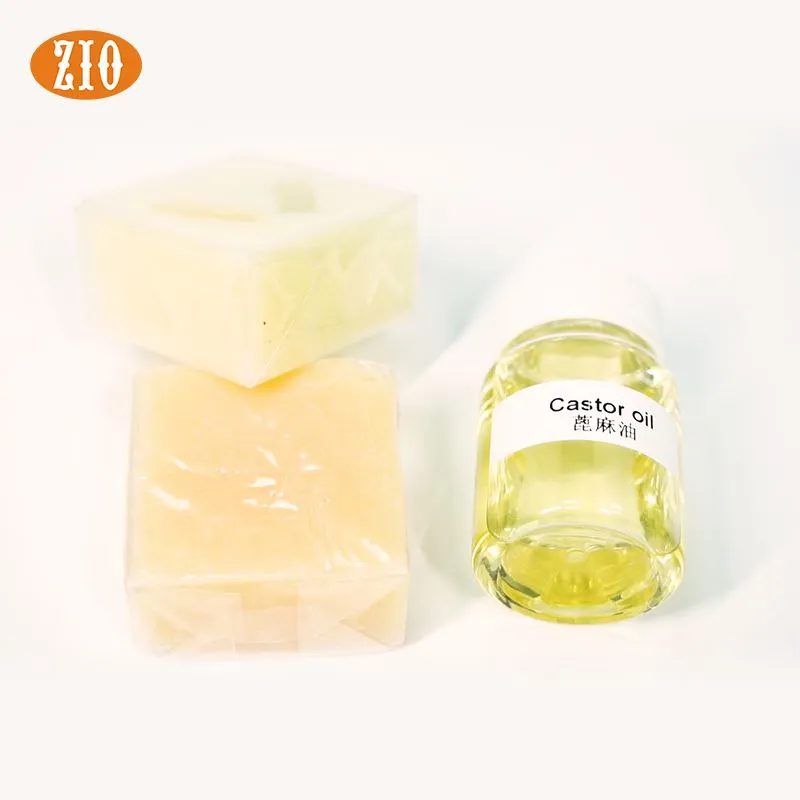
This product is an almost colorless or slightly yellowish clear and viscous liquid; it has a faint odor; and its taste is mild and then slightly pungent. This product is soluble in ethanol and can be mixed arbitrarily with anhydrous ethanol, chloroform, ether or acetic acid. Its density is 0.955 - 0.970 g/cm³, and its refractive index is 1.4765 - 1.4819.
Ricinoleic acid, after being treated with concentrated sulfuric acid, yields a surfactant with excellent surface activity (commonly known as Turkish red oil) and conjugated double bonds. By treating ricinoleic acid with different hydrogenation conditions, various products can be obtained. Therefore, ricinoleic acid is widely used in various industrial sectors.
The content of unsaponifiable substances in ricinoleic acid is less than 1%, and its vitamin content is relatively low (about 0.05).
Ricin seeds contain a high oil content. Due to the different uses of the oil, the oil extraction methods are also different. Medicinal ricin oil is cold-pressed using a water press machine, with a temperature not exceeding 50°C, otherwise some impurities will dissolve into the oil and cannot be used for medicinal purposes. The oil obtained from cold pressing is called 1st grade ricin oil. The cake is crushed and re-pressed or extracted to produce 3rd grade ricin oil, which is used for industrial purposes. Pressing directly with a screw press or using pre-extraction and extraction to obtain ricin oil can only be used as industrial oil.
Ricinoleic acid is a pale yellow viscous non-drying oil that can dissolve in most organic solvents, and it particularly has the characteristic of being soluble in alcohol.
Ricinoleic acid has good compatibility with nitrocellulose, ethyl cellulose, butyric acid cellulose, polyamide, formaldehyde resin, rosin, and shellac, and can also be used as a plasticizer. Additionally, it has good compatibility with polyvinyl butyral and chlorinated rubber.
Ricinoleic acid has good stability, color retention, flexibility, pigment dispersion, wetting, lubrication, low-temperature properties, electrical properties, and biological properties. Therefore, it can be combined and applied in varnish coatings, artificial leather, ink, sealants, lubricants, stationery, cosmetics, electrical insulation materials, medicine, etc.
Ricinoleic acid can undergo many chemical reactions through its hydroxyl groups, double bonds, and ester bonds, and the resulting products are widely used in the paint industry, plastic industry, rubber industry, building materials industry, metal industry, and mechanical industry.
Products Application
Used in the manufacturing of Turkish red oil, soap, plastic, lubricating oil, etc.; used in the production of daily cosmetics, shoe polish, medical ointments, it is the raw material for obtaining 12-hydroxy stearic acid; used in the production of decanoic acid, cold-resistant plasticizers, lubricants, fragrances, penetration agents for the textile industry, emulsifiers, etc.; used in the production of laxatives and zinc preparations; leather fatting agent; for the production of sulfated castor oil; enhancer and brightener for leather finishing; used in the manufacture of plasticizers, diacid, polyurethane coatings, rubber, adhesives, fatty acids, surfactants, insulating oil, hydraulic oil, lubricating oil, Turkish red oil, soap, polyamide-11 fibers, etc.
Castor oil undergoes dehydration to form conjugated double bond dry oil. Under different conditions, hydrogenation can yield various products, thus it is widely used in various industrial sectors. Medicinal castor oil is a stimulating laxative. It mainly acts on the small intestine and is used for laxation; as a lubricant; as a release agent; as a carrier solvent; and as a protective coating.
Products Qualification









Hot Tags: castor oil, China castor oil manufacturers, suppliers