



Products Description
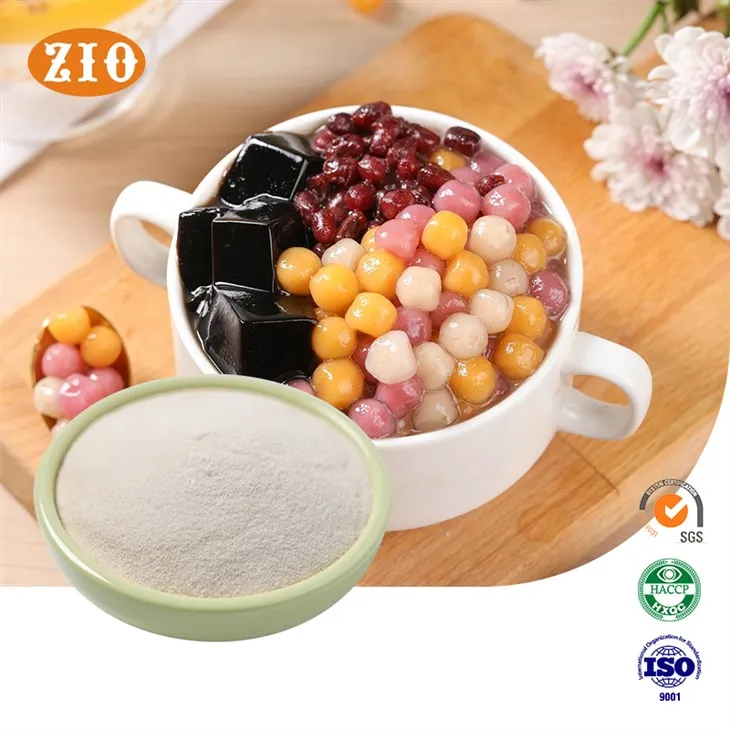
Xanthan gum is also known as yellow gum or Hansheng gum. It is an extracellular acidic heteropolysaccharide produced by the fermentation of Pseudomonas xanthan. It is a polysaccharide macromolecule composed of D-glucose, D-mannose and D-glucuronic acid in a ratio of 2:2:1, with a relative molecular mass of over 1 million. The secondary structure of xanthan gum is that the side chains wrap around the main chain skeleton in an opposite direction, and are maintained by hydrogen bonds to form a rod-shaped double helix structure.
Xanthan gum is a light yellow to white, flowable powder with a slight odor. It is soluble in cold and hot water, and the solution is neutral. It is resistant to freezing and thawing and does not dissolve in ethanol. When exposed to water, it disperses and emulsifies to form a stable hydrophilic viscous colloid.
|
Item |
Specification requirements |
detection result |
|
Appearance |
White to light beige powder |
Light yellow powder |
|
Viscosity (1% xanthan gum in 1% KCL in water) |
1200-1800cps |
1530 |
|
Shear value |
≥6.5 |
7.9 |
|
loss on drying |
≤15% |
7.51 |
|
granularity |
100% pass 60 mesh screen; At least 95% through the 80-mesh sieve. |
qualified |
|
ash content |
≤16% |
6.18 |
|
Pb |
≤ 2ppm |
< 2ppm |
|
total nitrogen |
≤ 1.5% |
0.73 |
|
acetylformic acid |
≥1.5% |
4.5 |
|
total numbers of colony |
≤5000 cfu/g |
qualified |
|
Mold and yeast |
≤500 cfu/g |
qualified |
|
coli group * |
≤3 MPN/g |
not detected |
|
salmonella * |
Not to be detected / 25g |
not detected |
|
* The project is a type inspection item, with sampling inspection once in half a year. |
||
|
Judgment conclusion: qualified. |
||
Products Funtion
Xanthan gum is currently the most superior biological gum in the world, integrating thickening, suspension, emulsification and stabilization functions. The number of pyruvic groups at the terminal of the molecular side chain of xanthan gum has a significant impact on its performance. Xanthan gum possesses the general properties of long-chain polymers, but it contains more functional groups than ordinary polymers, and shows unique properties under specific conditions. Its conformation in aqueous solution is diverse, and it exhibits different characteristics under different conditions.
1. Suspension and emulsification
Xanthan gum has a good suspension effect on insoluble solids and oil droplets. The xanthan gum solution molecules can form super-coordinated band-shaped helical copolymers, forming a fragile gel-like network structure, which can support the morphology of solid particles, droplets and bubbles, and shows strong emulsification stability and high suspension ability.
2. Excellent water solubility
Xanthan gum can dissolve quickly in water and has good water solubility. It can also dissolve in cold water, eliminating the need for complicated processing procedures and being convenient to use. However, due to its extremely strong hydrophilicity, if it is directly added to water and not stirred thoroughly, the outer layer will absorb water and expand into gel clusters, which will prevent water from entering the inner layer, thereby affecting the performance. Therefore, it is necessary to use it correctly. Xanthan gum powder or mixed with dry powder ingredients such as salt and sugar and then slowly added to the stirring water to form a solution for use.
3. Thixotropy
The xanthan gum solution exhibits the characteristic of high viscosity at low concentrations (the viscosity of a 1% aqueous solution is equivalent to 100 times that of gelatin), and it is an efficient thickening agent.
4. Viscoelasticity
The xanthan gum solution exhibits high viscosity under static or low shear conditions, shows a sharp decrease in viscosity under high shear conditions, but maintains its molecular structure. When the shear force is removed, it immediately returns to its original viscosity. The relationship between shear force and viscosity is completely plastic. The viscoelasticity of xanthan gum is very prominent. This viscoelasticity is extremely effective for stabilizing suspensions and emulsions.
5. Thermal stability
The viscosity of the xanthan gum solution does not change significantly with temperature. Unlike most polysaccharides, which undergo viscosity changes upon heating, the aqueous solution of xanthan gum shows almost no change in viscosity between 10-80°C. Even at low concentrations, the aqueous solution of xanthan gum still displays stable high viscosity over a wide temperature range. For a 1% xanthan gum solution (containing 1% potassium chloride) heated from 25°C to 120°C, its viscosity only decreased by 3%.
6. Stability to acids and bases
The xanthan gum solution is very stable to acids and bases. Its viscosity is not affected within the pH range of 5-10. At pH values less than 4 or greater than 11, the viscosity shows slight changes. Within the pH range of 3-11, the maximum viscosity is only about 10% higher than the minimum value. Xanthan gum can dissolve in various acid solutions, such as 5% sulfuric acid, 5% nitric acid, 5% acetic acid, 10% hydrochloric acid, and 25% phosphoric acid, and these xanthan gum acid solutions remain quite stable at room temperature and do not change for several months. Xanthan gum can also dissolve in sodium hydroxide solution and has thickening properties. The resulting solution is very stable at room temperature. Xanthan gum can be degraded by strong oxidants, such as perchloric acid and persulfate, and the degradation accelerates with increasing temperature.
7. Stability to salts
The xanthan gum solution can be miscible with many salt solutions (potassium salts, sodium salts, calcium salts, magnesium salts, etc.), and its viscosity is not affected. Under higher salt concentration conditions, even in saturated salt solutions, it still maintains its solubility without precipitation or flocculation, and its viscosity is almost unaffected.
8. Stability to enzymatic reactions
The stable double helix structure of xanthan gum gives it extremely strong antioxidant and anti-degradation capabilities. Many enzymes, such as proteases, amylases, cellulases, and hemicellulases, cannot degrade xanthan gum.
Products Application
Xanthan gum, due to its unique properties, has extremely wide applications in more than a dozen fields such as food, petroleum, medicine, and daily chemical products. Its commercialization level and application scope are far beyond those of any other microbial polysaccharide.
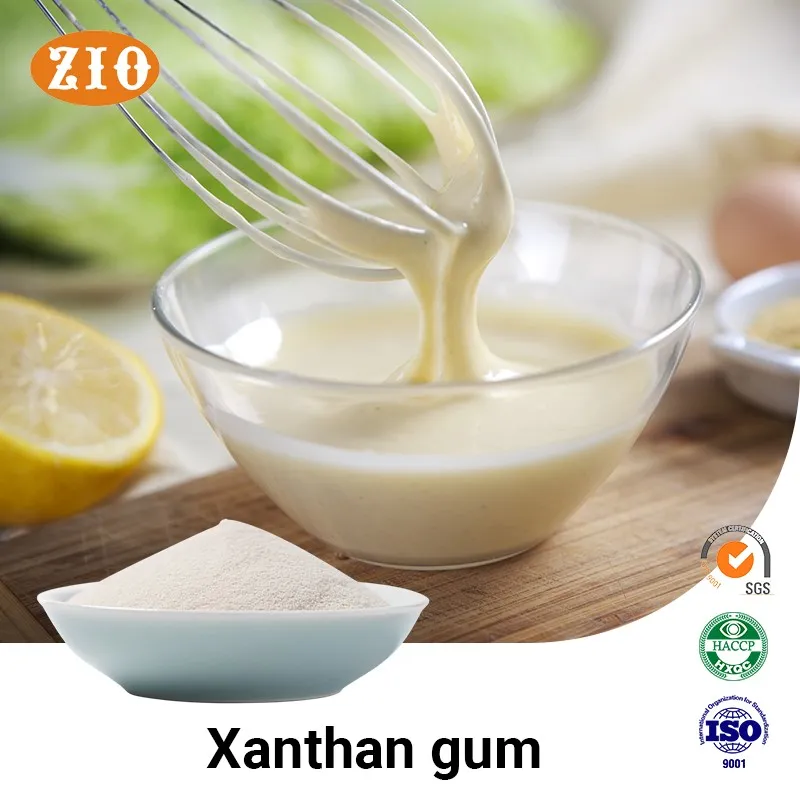
1. In the food industry: Xanthan gum is added to many foods as a stabilizer, emulsifier, suspending agent, thickener, and processing auxiliary agent. It can control the rheology, structure, flavor, and appearance of the products, and its pseudoplasticity can ensure a good taste. Therefore, it is widely used in salad dressings, bread, dairy products, frozen foods, beverages, seasonings, brewing, candies, pastries, soup stocks, and canned foods. In recent years, people in developed countries often worry that the high calorific value in food may cause them to gain weight. Xanthan gum, due to its inability to be directly degraded by the human body, has dispelled this concern. In addition, according to a report from Japan in 1985, after comparing and testing eleven food additives, xanthan gum was the most effective anti-cancer agent among them.
2. In the field of daily chemical products: Xanthan gum molecules contain a large number of hydrophilic groups and is a good surfactant. It also has antioxidant and anti-aging effects. Therefore, almost all high-end cosmetics use xanthan gum as their main functional component. In addition, xanthan gum can also be used as a component in toothpaste to increase viscosity and shape, and reduce tooth surface wear.
3. In the medical field: Xanthan gum is currently a functional component in the popular microcapsule drug carriers in the international market, playing an important role in controlling drug sustained-release. Due to its strong hydrophilicity and water retention properties, it also has many specific medical application aspects, such as forming a dense water film to avoid skin infection; alleviating patients' thirst after radiotherapy, etc. In addition, Li Xin and Xu Lei wrote that xanthan gum itself has a significant enhancing effect on the humoral immune function of mice.
4. In industrial and agricultural applications: In the petroleum industry, due to its strong pseudoplasticity, a 0.5% aqueous solution of xanthan gum at low concentration can maintain the viscosity of drilling fluid and control its rheological properties. Therefore, the viscosity is extremely low at the rotating part of the drill bit, saving power; while at the relatively stationary drilling part, it maintains high viscosity, thus preventing well wall collapse. And due to its excellent salt resistance and heat resistance, it is widely used in drilling in special environments such as the ocean and high-salt layer areas, and can be used as a drilling fluid for oil extraction to reduce dead oil areas and increase oil recovery rate.
Products Details
Products Qualification








Hot Tags: food grade xanthan gum, China food grade xanthan gum manufacturers, suppliers